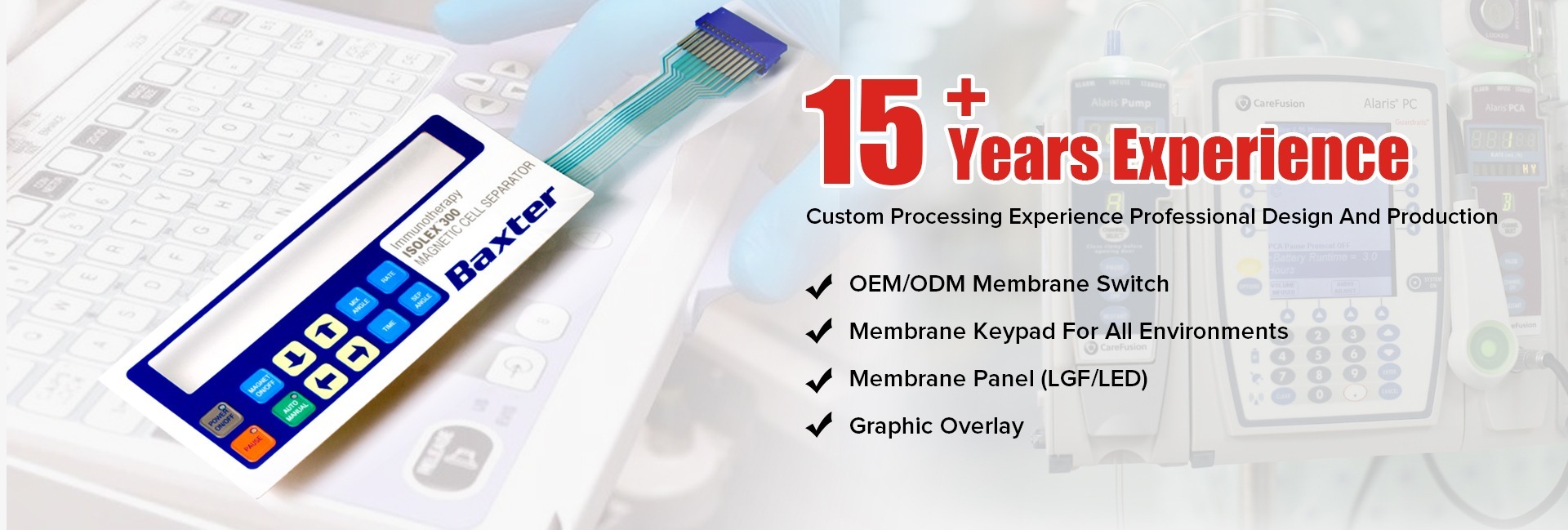
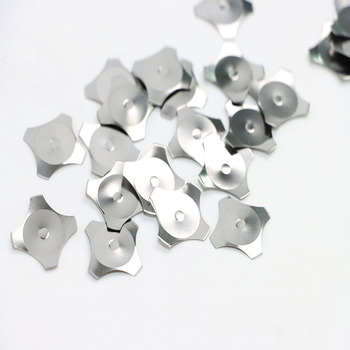
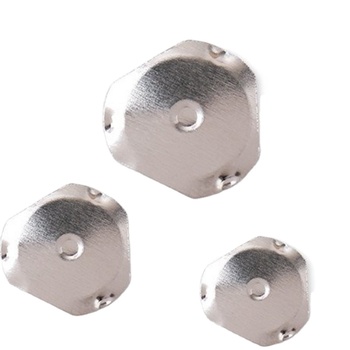
1. What is the fundamental difference between a 4-leg cross metal dome and a round dome, and how do I choose?
The primary differences center on circuit trace routing, tactile crispness, and PCB footprint. A 4-leg cross dome (such as 8.4mm or 10mm) provides distinct clearance openings between its legs, permitting electrical circuit traces to route directly underneath the dome on a single PCB or circuit layer. Furthermore, 4-leg domes deliver a higher Click Ratio (typically 45%–65%), resulting in an unmistakable mechanical click. Conversely, a round (circular) dome provides a completely symmetrical perimeter contact, requiring an open center pad and an outer ring pad. Round domes are selected when space is intensely constrained (down to 3.0mm diameter) or when an ultra-low profile (under 0.20mm total height) is required. If your board allows the footprint, 4-leg cross domes offer the highest stability and assembly tolerance.
2. Why do metal domes fail prematurely or feel 'mushy' after lamination, and how is it prevented?
Over 80% of perceived dome switch failures are caused by air entrapment and improper actuator clearance, not defective stainless steel. When a dome snaps downward, the trapped pocket of air beneath the dome cavity must escape instantly. If spacer adhesive layers lack laser-cut micro-vent channels connecting the domes to an ambient expansion reservoir, trapped air creates pneumatic back-pressure (hydraulic damping). This softens the click, increases contact resistance, and can cause the dome to become inverted or stick down. At Dongguan Cevra Electronic Technology Co., Ltd., our engineering team verifies CAD vent channel pathways on every custom array sheet to ensure unhindered airflow while preserving IP65/IP67 ingress sealing.
3. When should we specify Gold Plating versus Nickel Plating or Bare Stainless Steel?
Plating choice is governed by circuit voltage/current levels and ambient corrosive factors:
• Bare Stainless Steel (SUS301): Excellent spring elasticity and lowest cost; best suited for standard commercial keypads with circuit currents above 10mA where mechanical switching wipes minor surface oxidation.
• Nickel Plating: Enhances corrosion resistance in high-humidity or industrial environments and lowers contact resistance below 1.0 Ω. Highly cost-effective for general industrial and white goods appliances.
• Gold Plating: Imperative for low-voltage, low-current "dry circuits" (<5V, <1mA), medical monitors, aerospace avionics, and environments exposed to airborne sulfur or chlorine. Gold prevents micro-oxidation, guaranteeing stable sub-ohm contact resistance across 5,000,000 cycles.
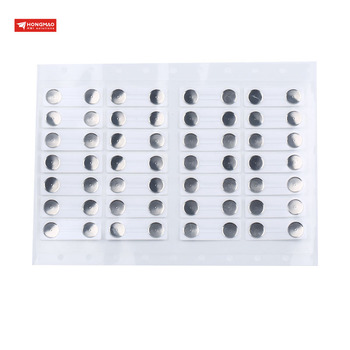
4. What is the difference between loose domes in tape-and-reel versus custom metal dome arrays?
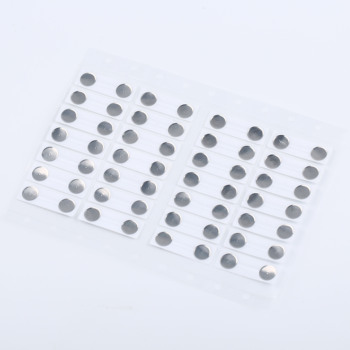
Loose metal domes can be placed via SMT pick-and-place equipment or hand tweezers onto PCBs. However, loose domes require solder paste or secondary adhesive dots, which risks flux contamination creeping onto the contact points and causing intermittent open circuits. Pre-assembled Metal Dome Arrays (Dome Sheets) consist of domes pre-positioned on a precision die-cut polyester carrier sheet backed by acrylic pressure-sensitive adhesive. The entire multi-switch array is peeled and adhered to the PCB or membrane circuit in a single 5-second operation. This guarantees ±0.05mm positioning, built-in venting channels, zero solder flux hazards, and massive reductions in factory assembly labor costs.
5. What exact documentation does Dongguan Cevra Electronic Technology Co., Ltd. need to provide a rapid quote and DFM review?
To provide a detailed manufacturing quote within 24 hours, our engineering department requests:
1. Mechanical Drawing / Artwork: Vector files in DXF, DWG, STEP, or layered AI/PDF format showing switch center coordinates, dome outer boundaries, and overall dimensions.
2. Tactile Parameters: Target dome diameter (e.g., 8.4mm, 10mm, 12mm), preferred trip force (e.g., 220g, 280g, 350g), and whether a center dimple is desired.
3. Stack-up Specifications: Plating preference (Bare, Nickel, Gold), adhesive backing specification (e.g., 3M 467MP, 3M 468MP), and single-layer vs. double-layer spacer requirements.
4. Project Volume: Initial prototype quantities and estimated annual volume (EAV) for batch volume pricing.
6. How does your facility verify dome actuation force and cycle durability prior to shipment?
Quality assurance at Dongguan Cevra Electronic Technology Co., Ltd. is managed in accordance with our ISO 9001 quality management framework. Incoming SUS301 stainless steel strips undergo tensile strength and metallurgical hardness testing. During production, samples from each stamping lot are tested on our Automated Fragment Load Tester to plot the exact Force-Displacement curve, ensuring trip force (F1) and return force (F2) fall strictly within ±20g to ±30g tolerances. In addition, our lab conducts continuous mechanical endurance cycling tests, CCD optical alignment audits, peel adhesion testing, and environmental cycling in high/low temperature chambers (-40°C to +85°C).